I have been unable to access my email all week.
Yes, I am one of those stupid, stupid people who does web-mail and does not back any of it up. Periodically I go through my Inbox (dating back to early 2000) and delete all the mail I don't want to keep. This generally creates enough space in my inbox for me to continue functioning on the "free" level, without having to upgrade my status to Preferred Member (which really just means I have to pay to do what I did for free, before).
My husband (who makes his living in computers) has been telling me for ages that I need to do my mail differently. And he has even offered to set it all up for me.
Now, I am one of those people who can't be bothered. And I don't mean that I won't work very hard to get something or I don't want to get a little dirt under my fingernails. I mean that I literally can't be bothered about certain things, much the way I described Eliot in my story, running.
Unlike ninety percent of America's women, I generally have only one pair of shoes at a time. I just can't be bothered to care about shoes. If my shoes are worn out, I'll keep wearing them without thinking about it, until one rainy day when I step in a puddle and have to live the rest of the day with a water-logged sock. And I will live the rest of the day with that sock, rather than run to my bedroom to change it, because, well, I simply can't be bothered. And even then, I am as likely as not to step in another puddle the very next day and the next week and the next month, before I finally, probably on impulse, buy a new pair of shoes. I am adaptable. To anything. This is good in some respects. But every now and then I'll see a stack of books on the floor in front of the bookcase or glance at the china cabinet where a game that we played a year ago still sits, or I'll take last-year's overlooked Christmas ornament from the top of the microwave to put it on this year's tree, and I'll think, "I really should take more notice of things. My life is all about reaction and not at all about prevention.
It shouldn't surprise me, then, that when I tried this morning, for the 6th consecutive day, to check my email, I was able to access my mailbox only to find that it had been wiped clean. All of my mail from anybody for the last six years is gone. And unless Mail.com finds the method and the generosity to restore it for me, I will never see it again.
I'm trying to decide if this matters to me. On the one hand, I kept all that mail for a reason, and my relationship with all of you who email me is important to me. Also, although perhaps somewhat sadly, most of my friendships and the larger part of those individual friendships have taken place via email.
On the other hand, how important is it that I hoard or revisit those conversations? I have my memory. I carry them with me. I don't remember many specific emails, but the whole of those conversations, over the years, has informed the way I know each person and the way I know myself, because of him or her. Life is organic. When we try to go back in memory to a specific place or time, it is all different, anyway, even if we've taken great pains to preserve it intact.
Several months ago I sorted through my "Treasure Box", a box containing memorabilia from my childhood and adolesence. The treasures therein did not give me the pleasure I thought they would, though many of them I would never part with, willingly: like the letter my older brother gave me at Summer Camp one year.
Camp Gitchee Gumee set up a "Secret-Brother, Secret-Sister" arrangement on the first day of camp. Every boy was given a girl's name at random and every girl was given the name of a boy. During the week each camper was to write friendly notes or give small gifts to the person bearing the name on his or her slip.
About mid-week I understood that whatever boy drew my name out of the hat must have asked someone to point me out and realized he'd drawn the short stick. I cried. I withdrew. I couldn't look in the mirror at my fuzzy hair and my awkward body draped with garage sale clothes. I knew that some boy had been sorely disappointed and didn't want to risk peer-taunting, even to send me a friendly note.
The next day one of my cabin mates handed me a folded letter. On the outside were the printed words, "From your Secret Brother." Inside were several kind paragraphs, replete with mis-spellings and poor grammar, but to me they could have won the Nobel Prize for Literature.
At the end of the week, when the Secret Siblings were revealed and nobody stood up and showed himself when my name was called, the truth slowly began to dawn on me.
Michael told me later that he had asked a girl to write the letter for him, so I wouldn't recognize his handwriting, and that he'd dictated the mis-spellings and grammatical mistakes so as not to arouse suspicion, because most pre-teen boys just don't know how to write.
I wasn't let down when I learned the truth. I was used to being overlooked, especially by boys. But not another girl in that whole camp had a brother who loved her the way mine loved me.
I still have the note, tucked away in a box somewhere in my garage. And I'm glad I have it. But what's really significant is that it did exist, and I read it, and I learned something because of it, and I carry that tender piece of my brother with me every time we talk.
Thursday, February 16, 2006

Monday, February 13, 2006
Flu Reflections
I spent the weekend with the flu and Dorothy Day's autobiography, "The Long Loneliness".
I am struck by the vast difference between the world then (early 1900's) and our current world. Has human life ever changed more rapidly than in the 20th century?
Dorothy Day was Catholic, a non-violent social activist and a writer, who lived in Chicago and New York during prohibition (though bootleggers were plenty) and in a time when women were not allowed to smoke in public or to vote. Day went to work on a newspaper, reporting social injustice wherever she saw it. Labor Laws and worker's rights were largely non-existent (a 14 year old boy working 90 hours/week, injured workers left without compensation to beg on the streets, the poor working themselves to death and relegated to unsanitary housing). Most young social activists of her day were Communists (or the more benign, Socialist) and Anarchists and sometimes resorted to violence in protest of the corrupt social order, but to a large degree they were peaceful protesters who picketed or wrote and spoke against injustice. Still, almost all Dorothy's friends were arrested multiple times, and during this time some Radicals were tried and sentenced to death.
We have undoubtedly made social progress since then. Women have voting privileges (and I can't believe how begrudgingly I accept this right), there are child-labor laws and, despite low wages and run-down housing for the poor, there are laws governing minimum wage and work-week hours and there is compensation for occupational injury and medicaid and food stamps and WIC. It is helpful to me, to look back at where we've been and appreciate how far we've come. I would not dare purport that our current system is in all points just or that our existing programs are sufficiently effective, but we do a disservice to the remembrance of all who worked and fought for reforms when all we manage is to sit back and complain.
At the same time, I'm in a bit of a quandary when I think about our responsibility to carry on their work. The climate has changed so much. The world has changed so much. As I see it, at least two major changes make responsible social activism very difficult.
First, we have "specialized" everything and everyone. When Dorothy Day left her parents' home at 16, she attended University for two years, on a scholarship of $300 (semester tuition fees at the University of Illinois were $12.00), which covered books, tuition, and most living expenses. She took various odd jobs and living situations to cover the rest. After two years she took a job as a reporter with the Call, a socialist newspaper . During World War I she joined a hospital nursing program, which trained its students on the job, with three hour breaks in the afternoon for lectures and training seminars.
Today, a minimum of four years higher education is required to get a job in just about anything, outside of the most basic customer service jobs, and the cost of education is unattainable for all but the wealthiest few. An untrained person can't just volunteer to become a nurse and an eighteen year-old with "some college" is not going to land a reporting job, nomatter what kind of paper or what kind of writer.
The second obstacle to social activism is a prevailing social attitude that equates radicalism with lunacy or barbarism. Dorothy Day was arrested for a peaceful women's suffrage demonstration on the White House lawn; today picketing is associated with crazy fundamentalists in front of abortion clinics (who are often hauled off to jail just as Day was). We look, in retrospect, at her activism as heroic and necesary for social reform; why are today's activists on both sides of the political spectrum (Pro-lifers and Environmentalists) written off as mentally imbalanced or intolerant or at best, annoyances to roll our collective, enlightened eyes at? We are told that we can't "legislate morality". But then how do we procure change? Weren't Women's Suffrage and Labor Unions and the Civil Rights Movement exactly that, attempts to legislate morality, so that society would run by more moral laws?
In general, I see my life as being full of restrictions. I found myself complaining to a friend just the other day that I feel stuck in the "this is how things are done" rut, and I lamented my deplorable lack of imagination. I want to do something, but I don't know what to do. Whereas the world of 1915 was wide open, almost begging individuals to stand in the gaps and shape the future, the world of 2006 feels closed to me. If I want to help the sick I need training in the medical profession. If I want to help poor families or orphans or victims of abuse, I've got to become a "social worker". I don't even qualify to counsel pregnant teenagers, even though I was one 15 years ago, and have felt the weight of it every day since.
Maybe I'm being obtuse and looking at the roadblock instead of the grassy bank that winds around it. I know I can donate food and clothing to charities and I can help serve meals at a shelter. I can give money. I can pray. I can vote. I can practice kindness. Am I the only one who feels immobilized in the face of it all?
Although she eventually converted to Catholicism in her thirties, Dorothy Day rejected Christianity for agnosticism in her college years. Here is her account of it:
I want to understand my place in all of this. Certainly, Christianity as I have known it is far from this abundant life. Is there even a line of demarcation between the church and the world? When I was small I thought as Dorothy did and I was full of zeal to be Christ to a hurting world. Popular culture must have a sinister goal- or perhaps it is merely a natural side-effect- of squelching virtuous passions, while feeding destructive ones to bursting. I have tried to close my mind to its inundations, and still I find I have been mesmerized, sedated, lulled into a life of dangerous conformity and appalling self-absorption.
And I will probably join you, when you roll your eyes at me and tell me I'm being overly dramatic. And I will probably agree with all your assesments of "youthful idealism" vs. the "wisdom of age". And I will probably laugh when you say that the flu "went to my head" and concede that I "shouldn't be too hard on" myself. But then there are those disturbing Biblical words:
I am struck by the vast difference between the world then (early 1900's) and our current world. Has human life ever changed more rapidly than in the 20th century?
Dorothy Day was Catholic, a non-violent social activist and a writer, who lived in Chicago and New York during prohibition (though bootleggers were plenty) and in a time when women were not allowed to smoke in public or to vote. Day went to work on a newspaper, reporting social injustice wherever she saw it. Labor Laws and worker's rights were largely non-existent (a 14 year old boy working 90 hours/week, injured workers left without compensation to beg on the streets, the poor working themselves to death and relegated to unsanitary housing). Most young social activists of her day were Communists (or the more benign, Socialist) and Anarchists and sometimes resorted to violence in protest of the corrupt social order, but to a large degree they were peaceful protesters who picketed or wrote and spoke against injustice. Still, almost all Dorothy's friends were arrested multiple times, and during this time some Radicals were tried and sentenced to death.
We have undoubtedly made social progress since then. Women have voting privileges (and I can't believe how begrudgingly I accept this right), there are child-labor laws and, despite low wages and run-down housing for the poor, there are laws governing minimum wage and work-week hours and there is compensation for occupational injury and medicaid and food stamps and WIC. It is helpful to me, to look back at where we've been and appreciate how far we've come. I would not dare purport that our current system is in all points just or that our existing programs are sufficiently effective, but we do a disservice to the remembrance of all who worked and fought for reforms when all we manage is to sit back and complain.
At the same time, I'm in a bit of a quandary when I think about our responsibility to carry on their work. The climate has changed so much. The world has changed so much. As I see it, at least two major changes make responsible social activism very difficult.
First, we have "specialized" everything and everyone. When Dorothy Day left her parents' home at 16, she attended University for two years, on a scholarship of $300 (semester tuition fees at the University of Illinois were $12.00), which covered books, tuition, and most living expenses. She took various odd jobs and living situations to cover the rest. After two years she took a job as a reporter with the Call, a socialist newspaper . During World War I she joined a hospital nursing program, which trained its students on the job, with three hour breaks in the afternoon for lectures and training seminars.
Today, a minimum of four years higher education is required to get a job in just about anything, outside of the most basic customer service jobs, and the cost of education is unattainable for all but the wealthiest few. An untrained person can't just volunteer to become a nurse and an eighteen year-old with "some college" is not going to land a reporting job, nomatter what kind of paper or what kind of writer.
The second obstacle to social activism is a prevailing social attitude that equates radicalism with lunacy or barbarism. Dorothy Day was arrested for a peaceful women's suffrage demonstration on the White House lawn; today picketing is associated with crazy fundamentalists in front of abortion clinics (who are often hauled off to jail just as Day was). We look, in retrospect, at her activism as heroic and necesary for social reform; why are today's activists on both sides of the political spectrum (Pro-lifers and Environmentalists) written off as mentally imbalanced or intolerant or at best, annoyances to roll our collective, enlightened eyes at? We are told that we can't "legislate morality". But then how do we procure change? Weren't Women's Suffrage and Labor Unions and the Civil Rights Movement exactly that, attempts to legislate morality, so that society would run by more moral laws?
In general, I see my life as being full of restrictions. I found myself complaining to a friend just the other day that I feel stuck in the "this is how things are done" rut, and I lamented my deplorable lack of imagination. I want to do something, but I don't know what to do. Whereas the world of 1915 was wide open, almost begging individuals to stand in the gaps and shape the future, the world of 2006 feels closed to me. If I want to help the sick I need training in the medical profession. If I want to help poor families or orphans or victims of abuse, I've got to become a "social worker". I don't even qualify to counsel pregnant teenagers, even though I was one 15 years ago, and have felt the weight of it every day since.
Maybe I'm being obtuse and looking at the roadblock instead of the grassy bank that winds around it. I know I can donate food and clothing to charities and I can help serve meals at a shelter. I can give money. I can pray. I can vote. I can practice kindness. Am I the only one who feels immobilized in the face of it all?
Although she eventually converted to Catholicism in her thirties, Dorothy Day rejected Christianity for agnosticism in her college years. Here is her account of it:
I did not see anyone taking off his coat and giving it to the poor. I didn't see anyone having a banquet and calling in the lame, the halt and the blind. And those who were doing it, like the Salvation Army, did not appeal to me. I wanted, though I did not know it then, a synthesis. I wanted life and I wanted the abundant life. I wanted it for others too. I did not want just the few, the missionary-minded people like the Salvation Army, to be kind to the poor, as the poor. I wanted everyone to be kind. I wanted every home to be open to the lame, the halt and the blind, the way it had been after the San Francisco earthquake. [which she experienced in her childhood neighborhood] Only then did people really live, really love their brothers. In such love was the abundant life and I did not have the slightest idea how to find it.
I want to understand my place in all of this. Certainly, Christianity as I have known it is far from this abundant life. Is there even a line of demarcation between the church and the world? When I was small I thought as Dorothy did and I was full of zeal to be Christ to a hurting world. Popular culture must have a sinister goal- or perhaps it is merely a natural side-effect- of squelching virtuous passions, while feeding destructive ones to bursting. I have tried to close my mind to its inundations, and still I find I have been mesmerized, sedated, lulled into a life of dangerous conformity and appalling self-absorption.
And I will probably join you, when you roll your eyes at me and tell me I'm being overly dramatic. And I will probably agree with all your assesments of "youthful idealism" vs. the "wisdom of age". And I will probably laugh when you say that the flu "went to my head" and concede that I "shouldn't be too hard on" myself. But then there are those disturbing Biblical words:
Religion that God our Father accepts as pure and faultless is this: to look after orphans and widows in their distress and to keep oneself from being polluted by the world.
James 1:27 (NIV)
Monday, February 06, 2006
Johnny
When I was almost three, a dark man and woman knocked on the door of our gold, shoebox house on Locke Avenue and wanted to buy it, so we moved “Out to the Country”. We lived in a square white house with two levels and black shutters and a concrete front porch, sporting rectangular pillars. A Weeping Willow yawned in the front yard near the ditch that ran along Eighth Avenue; the ditch I squatted by and caught pollywogs and fat brown toads and made mud-pies with Johnny Height, my next-door neighbor with wild blond curls and a cap-gun. My brother and I weren’t allowed guns, so Johnny cut an unsettling figure, running around the neighborhood like a renegade, bare-chested with cut-off blue jeans and a holster slung low about his hips.
The gun wasn’t the only dangerous thing about Johnny. He never got spankings, for one thing, and he had a dirty mouth. He was an only child and I remember seeing his parents only a few times, when my brother was lost in a book and my desire for a playmate outweighed my fear of knocking on Johnny’s door. His mother was a left-over Hippie, with straight black hair that fell down in front of her shoulders. She had yellow teeth and a cigarette in her left hand and she never addressed me by name or seemed very interested in me, or in Johnny, either. I think she invited me in once, in the five years we lived there. The house was strewn with cigarette butts and dog hair and when I came home my mother scrubbed my hair and clothes to get out their smell.
Johnny’s dad looked a lot like Johnny, but bigger, and wore a bare chest with just as much ease. He parked a beat up Chevrolet in the back yard some time before my memory; put it up on cement blocks and left it there. Black-Eyed Susans and wild rhubarb grew up around it, in the thick, uncut grass. Johnny showed me the best patch of rhubarb, alongside the back wall of his house. He cut gigantic purple stalks with his jack-knife and gnawed on the juicy ends.
The Heights didn’t go to church and had an old hound named Reefer. Johnny thought this name was funny and liked to say it a lot, but once, when the subject surfaced at home, my dad grew angry and my mother’s posture drooped. She turned quiet and sighed and I thought she was going to cry. Johnny Height and his parents and his dog became my first demonstrable link to the word “heathen”.
One time while we were playing hopscotch in the driveway, my stomach knotted up with conviction and wouldn’t let go. I took Johnny by the hand and led him to a shadowed corner of my basement, behind a rocking chair, and made him pray the Sinner’s Prayer. He didn’t really want to, but my vivid explanation of the torments of Hell made him more willing. I could be pretty persuasive already at five or six. I waxed eloquent, like a tent-revival preacher and tried to measure my effectiveness by Johnny’s face. He teetered on the edge of decision, his eyes shifting from me to the marbled shag carpeting, to the stairway that led back outside. Time to close the deal:
“Anyway, I won’t play with you any more until you say it”, I blurted, thinking of mud-pies and tadpoles and rhubarb and hoping he didn’t hold me to my words, in the event that he was blinded to the truth and damned, after all.
“Okay.” He shifted his agile body awkwardly, and half-closed his eyes.
“Repeat after me,” I said.
When we had finished a sufficiently salvific prayer I told him we were done. He opened his eyes.
I looked for the bare-chested cowboy with hands quick on the draw, hands which caught twice as many frogs as mine and were both surer and freer with a Frisbee or the branches of a tree. Johnny’s hands lay folded strangely on his lap, his face was flushed and funny and he wouldn’t meet my gaze.
“Can we play now?”
“Yes”. I stood up, suddenly tired and wondering why my legs were shaking and why I felt so crummy when I’d just saved a soul.
It was maybe ten minutes before Johnny’s movements quickened again and the fire lit in his sky-blue eyes, but it was ten years before I tried my hand at Conversion again.
We played long into the summer evening shadows that day and many other days, and when my family moved, the summer I was eight, Johnny was the only one who saw me sneak around the side of my house to hug it at the back corner and to look one more time at the Black-Eyed Susan’s and the broad-leafed rhubarb in his backyard.
The gun wasn’t the only dangerous thing about Johnny. He never got spankings, for one thing, and he had a dirty mouth. He was an only child and I remember seeing his parents only a few times, when my brother was lost in a book and my desire for a playmate outweighed my fear of knocking on Johnny’s door. His mother was a left-over Hippie, with straight black hair that fell down in front of her shoulders. She had yellow teeth and a cigarette in her left hand and she never addressed me by name or seemed very interested in me, or in Johnny, either. I think she invited me in once, in the five years we lived there. The house was strewn with cigarette butts and dog hair and when I came home my mother scrubbed my hair and clothes to get out their smell.
Johnny’s dad looked a lot like Johnny, but bigger, and wore a bare chest with just as much ease. He parked a beat up Chevrolet in the back yard some time before my memory; put it up on cement blocks and left it there. Black-Eyed Susans and wild rhubarb grew up around it, in the thick, uncut grass. Johnny showed me the best patch of rhubarb, alongside the back wall of his house. He cut gigantic purple stalks with his jack-knife and gnawed on the juicy ends.
The Heights didn’t go to church and had an old hound named Reefer. Johnny thought this name was funny and liked to say it a lot, but once, when the subject surfaced at home, my dad grew angry and my mother’s posture drooped. She turned quiet and sighed and I thought she was going to cry. Johnny Height and his parents and his dog became my first demonstrable link to the word “heathen”.
One time while we were playing hopscotch in the driveway, my stomach knotted up with conviction and wouldn’t let go. I took Johnny by the hand and led him to a shadowed corner of my basement, behind a rocking chair, and made him pray the Sinner’s Prayer. He didn’t really want to, but my vivid explanation of the torments of Hell made him more willing. I could be pretty persuasive already at five or six. I waxed eloquent, like a tent-revival preacher and tried to measure my effectiveness by Johnny’s face. He teetered on the edge of decision, his eyes shifting from me to the marbled shag carpeting, to the stairway that led back outside. Time to close the deal:
“Anyway, I won’t play with you any more until you say it”, I blurted, thinking of mud-pies and tadpoles and rhubarb and hoping he didn’t hold me to my words, in the event that he was blinded to the truth and damned, after all.
“Okay.” He shifted his agile body awkwardly, and half-closed his eyes.
“Repeat after me,” I said.
When we had finished a sufficiently salvific prayer I told him we were done. He opened his eyes.
I looked for the bare-chested cowboy with hands quick on the draw, hands which caught twice as many frogs as mine and were both surer and freer with a Frisbee or the branches of a tree. Johnny’s hands lay folded strangely on his lap, his face was flushed and funny and he wouldn’t meet my gaze.
“Can we play now?”
“Yes”. I stood up, suddenly tired and wondering why my legs were shaking and why I felt so crummy when I’d just saved a soul.
It was maybe ten minutes before Johnny’s movements quickened again and the fire lit in his sky-blue eyes, but it was ten years before I tried my hand at Conversion again.
We played long into the summer evening shadows that day and many other days, and when my family moved, the summer I was eight, Johnny was the only one who saw me sneak around the side of my house to hug it at the back corner and to look one more time at the Black-Eyed Susan’s and the broad-leafed rhubarb in his backyard.
Wednesday, February 01, 2006
Maybe God Created Me to Get My Children
My two oldest boys have found new respective occupations this past week, which has made the house much quieter.
While all of our boys love books, Micah (9) is sometimes difficult to coax into one. Micah is a man of action and interaction; he is drawn to computer games and board games and cooking and playing with friends and pushing his brothers. He is prone to nagging and boredom. He loses interest in a story more quickly than does Marshall, and will sometimes leave a book un-finished.
Last week he chose Madeleine L'Engle's "A Wrinkle in Time" for an upcoming book report in school. He has read good books before, including the Narnia books amd Harry Potter, and he has enjoyed them. But something in "A Wrinkle in Time" caught him in a new way. He has finished the first book and is on to the second in the series. He's reading before school in the morning and after school whenever he is not eating, doing homework or playing piano.
My children's school, North Hills Classical Academy, is helping each grammar-school child write and "publish" a book, to be completed by the end of this year. Marshall (11) started writing and hasn't stopped. He's in the middle of two stories, one for the school project and one "just for myself". He is getting up early (6:30 a.m.) to write. (Oh, that his mother could acquire such discipline!)
Mark my words: within five years Marshall will be a better writer than I am. At least as concerns fiction. Here is a teaser:
Continuing...
At the Head Government Building...
"Beat this!" yelled Zash as he ran toward the wall of the building, jumped, ran up the wall a ways, turned around on the wall, and ran back, brandishing his weapon.
"That's easy!" replied Slash. Then he did the same move, but in a slightly more impressive manner.
No, Marshall has never seen the Matrix.
Ummmm... Perhaps he knows more about reproduction than I thought? He seemed to think this line was funny.
Zecor has now infiltrated the government building:
And one more bit of humor, as Zecor confronts Rash, the leader of Silver.
For anyone who's interested, I can let you know how the story ends, but it's shaping up to be a long one.
While all of our boys love books, Micah (9) is sometimes difficult to coax into one. Micah is a man of action and interaction; he is drawn to computer games and board games and cooking and playing with friends and pushing his brothers. He is prone to nagging and boredom. He loses interest in a story more quickly than does Marshall, and will sometimes leave a book un-finished.
Last week he chose Madeleine L'Engle's "A Wrinkle in Time" for an upcoming book report in school. He has read good books before, including the Narnia books amd Harry Potter, and he has enjoyed them. But something in "A Wrinkle in Time" caught him in a new way. He has finished the first book and is on to the second in the series. He's reading before school in the morning and after school whenever he is not eating, doing homework or playing piano.
My children's school, North Hills Classical Academy, is helping each grammar-school child write and "publish" a book, to be completed by the end of this year. Marshall (11) started writing and hasn't stopped. He's in the middle of two stories, one for the school project and one "just for myself". He is getting up early (6:30 a.m.) to write. (Oh, that his mother could acquire such discipline!)
Mark my words: within five years Marshall will be a better writer than I am. At least as concerns fiction. Here is a teaser:
Zecor was waking up. It was not terribly early nor terribly late, but the sun was shining brightly. Zecor, like everyone else in Platinum, was a robot.
Zecor half reluctantly rose from his bed. He put on his removable armor, which was only taken off during the night. This certain armor covers the head, back and shoulder area and is unique to this particular type of robot.
Continuing...
I must tell you that Zecor had long envied the position of Rash, leader of the group Sliver. Silver was a group of three robots who fought crime and protected the whole of Platinum.
Zecor suddenly had an idea.He came up with this idea without trying to. There is no way to tell how he thought of it but... he thought, "If I secretly kill Rash, then I might make it up to his position."
With this plan still fresh on his mind, Zecor rushed through the crowds, which were quickly gathering as the morning progressed. As he pushed and shoved through the population on the street, his plans grew greater and nastier.
At the Head Government Building...
Zash and Slash, Rash's two companions, were competing in their acrobatic and weapon-handling skills.
"Beat this!" yelled Zash as he ran toward the wall of the building, jumped, ran up the wall a ways, turned around on the wall, and ran back, brandishing his weapon.
"That's easy!" replied Slash. Then he did the same move, but in a slightly more impressive manner.
No, Marshall has never seen the Matrix.
Zash and Slash are twins, which is a complicated thing for robots.
Ummmm... Perhaps he knows more about reproduction than I thought? He seemed to think this line was funny.
Zecor has now infiltrated the government building:
It took Zecor very little time to reach the stairs. From the bottom of the stairs he proceeded to the second floor. Going up, Zecor went a bit faster than he meant to. It was a strike of luck that nobody saw him ascend.
And one more bit of humor, as Zecor confronts Rash, the leader of Silver.
"Hello! I believe your name is Rash?" said Zecor.
"Yes, it is. And, by the way, my name does not describe my personality. What do you need?" Rash said, kindly.
For anyone who's interested, I can let you know how the story ends, but it's shaping up to be a long one.
Monday, January 30, 2006
The Weight of Glory
C.S. Lewis, in The Weight of Glory, says that human longing points to the existence of God and after-life, in which we will be made perfect or fulfilled. What follows is the relevant part of his essay to what I have just said about beauty:
"In speaking of this desire for our own far-off country,... I feel a certain shyness. I am almost committing an indecency. I am trying to rip open the inconsolable secret in each one of you - the secret which hurts so much that you take your revenge on it by calling it names like Nostalgia and Romanticism and Adolescence; the secret also which pierces with such sweetness that when, in very intimate conversation, the mention of it becomes imminent, we grow awkward and affect to laugh at ourselves; the secret we cannot hide and cannot tell, though we desire to do both. We cannot tell it because it is a desire for something that has never actually appeared in our experience. We cannot hide it because our existence is constantly suggesting it, and we betray ourselves like lovers at the mention of a name. Our commonest expedient is to call it beauty and behave as if that had settled the matter. Wordsworth's expedient was to identify it with certain moments in his own past. But all this is a cheat. If Wordsworth had gone back to those moments in the past, he would not have found the thing itself, but only the reminder of it; what he remembered would turn out to be itself a remembering. The books or the music in which we thought the beauty was located will betray us if we trust to them; it was not in them, it only came through them, and what came through them was longing. These things - the beauty, the memory of our own past - are good images of what we really desire; but if they are mistaken for the thing itself they turn into dumb idols, breaking the hearts of their worshippers. For they are not the thing itself; they are only the scent of a flower we have not found, the echo of a tune we have not heard, news from a country we have never yet visited."
Fear of Beauty
Why are we afraid of beauty? Here is the best explanation I can offer for my own fear. I'd really like to quote C.S. Lewis in The Weight of Glory, because, as with most things, Lewis just says it better. But, my answer first:
I fear beauty because it both requires something of me and shapes me into something.
Unasked for beauty surprises us in mundanity; I never escape the short walk from my house to my garage without a pang in my chest or a dip in the pit of my stomach. Earth and trees and sky are beautiful, in rain or sunshine, in blue, gray, brown or green. Sometimes, when I am far down and can't move my body from the couch, trees outside my window beckon me; squiggly-patterned gray bark and stark branches writhe atop stolid trunks, like Medusa's snakes. The trees know something that I do not. Or possess something. Something true; and they invite me in, to pass through them into this thing for which I do not have a name.
Other beauties call, too: kindness, deep laughter, a child’s smile. Beauty not only hints at a knowledge far beyond my own, it also calls me to be worthy of each special beauty, of the truth which beauty reflects. My most common experience in the face of it is pain- the pain of personal incongruity with beauty.
This is where I get stuck every time, because every time I choose not to answer beauty’s invitation. I can only conclude that I turn away out of fear. This second fear of beauty, I confess makes little sense to me.
Beauty, interacted with, makes us beautiful. Not much scares me more than this. I have gone to great lengths to define myself with words like depressed, unmotivated, unlovable, failed, confused, sinful, useless, lost. As long as I beat and imprison myself for past error, as long as I act as though I do not deserve grace or love or children or talent, my life is under my control, even if that control perpetuates self-hatred with bad choices and attitudes. When I am open to beauty my hands slip, I panic for fear of losing grip and being un-made, like Orual before the True God. And even more frightening, I will be re-made, and I will not be the maker.
Several years ago I had a recurring, half-waking dream. Just as I drifted into sleep, my body tingled, like a foot gone asleep or an epidural coursing through my veins or like regaining consciousness after passing out. Loud rushing filled my ears and both the sound and the numbness increased steadily. I knew I was coming to a point, a jumping-off point, but I didn’t know what lay beyond it: Death? Levitation? Ordinary sleep? I couldn’t move or make a sound or open my eyes when it began, but I fought and feared and fought some more. Each time I broke the spell just before sailing off the edge of the world. I’d wake up sweaty, heart thumping, and relieved, but terrified to go to sleep again. More than once I determined to embrace whatever approached; I’d jump and see what lurked in the great beyond. But I couldn’t do it.
Maybe it is too much to hope that God will welcome me. Maybe it is too much to ask that I wed my need to something as unstable as human love. Maybe it is too much to believe that I was made to drink beauty, to become beauty. It is too incredible. And it hurts.
I fear beauty because it both requires something of me and shapes me into something.
Unasked for beauty surprises us in mundanity; I never escape the short walk from my house to my garage without a pang in my chest or a dip in the pit of my stomach. Earth and trees and sky are beautiful, in rain or sunshine, in blue, gray, brown or green. Sometimes, when I am far down and can't move my body from the couch, trees outside my window beckon me; squiggly-patterned gray bark and stark branches writhe atop stolid trunks, like Medusa's snakes. The trees know something that I do not. Or possess something. Something true; and they invite me in, to pass through them into this thing for which I do not have a name.
Other beauties call, too: kindness, deep laughter, a child’s smile. Beauty not only hints at a knowledge far beyond my own, it also calls me to be worthy of each special beauty, of the truth which beauty reflects. My most common experience in the face of it is pain- the pain of personal incongruity with beauty.
This is where I get stuck every time, because every time I choose not to answer beauty’s invitation. I can only conclude that I turn away out of fear. This second fear of beauty, I confess makes little sense to me.
Beauty, interacted with, makes us beautiful. Not much scares me more than this. I have gone to great lengths to define myself with words like depressed, unmotivated, unlovable, failed, confused, sinful, useless, lost. As long as I beat and imprison myself for past error, as long as I act as though I do not deserve grace or love or children or talent, my life is under my control, even if that control perpetuates self-hatred with bad choices and attitudes. When I am open to beauty my hands slip, I panic for fear of losing grip and being un-made, like Orual before the True God. And even more frightening, I will be re-made, and I will not be the maker.
Several years ago I had a recurring, half-waking dream. Just as I drifted into sleep, my body tingled, like a foot gone asleep or an epidural coursing through my veins or like regaining consciousness after passing out. Loud rushing filled my ears and both the sound and the numbness increased steadily. I knew I was coming to a point, a jumping-off point, but I didn’t know what lay beyond it: Death? Levitation? Ordinary sleep? I couldn’t move or make a sound or open my eyes when it began, but I fought and feared and fought some more. Each time I broke the spell just before sailing off the edge of the world. I’d wake up sweaty, heart thumping, and relieved, but terrified to go to sleep again. More than once I determined to embrace whatever approached; I’d jump and see what lurked in the great beyond. But I couldn’t do it.
Maybe it is too much to hope that God will welcome me. Maybe it is too much to ask that I wed my need to something as unstable as human love. Maybe it is too much to believe that I was made to drink beauty, to become beauty. It is too incredible. And it hurts.
Tuesday, January 24, 2006
confession
Eliot is student of the week in his kindergarten class this week and I am trying unsuccessfully to put together a picture poster-board of his life for him to showcase before his classmates. I'm running into trouble because I have not put a single photograph of Eliot in a photo album.
I fell asleep seven years ago and I am not awake yet. I want to wake; I do. But waking images are sharp and cold and as vivid as the smell of rain in June. I am afraid. I will finally admit that I am afraid.
It has become easy for me to concede depression or angst; these adorn me like well worn clothes. But fear...
This afternoon as I flipped through jackets of long-abandoned pictures, I saw pieces of me and people I know or used to know, people I love or used to love.
Eliot is my favorite child because I have wronged him most. I was sleeping soundly when he was born and he withered away at my grudging breast. I roused enough to warm a bottle but then I slipped away again.
I came back when I had learned to sleep walk, and Eliot did not know me. He kept staring at me with a tentative grin. I didn't know him, either. I couldn't read what was behind his eyes.
Fear... I can tell you I'm afraid to fail; that keeps me and everybody else from expecting too much of me.
But really I am afraid of beauty.
I fell asleep seven years ago and I am not awake yet. I want to wake; I do. But waking images are sharp and cold and as vivid as the smell of rain in June. I am afraid. I will finally admit that I am afraid.
It has become easy for me to concede depression or angst; these adorn me like well worn clothes. But fear...
This afternoon as I flipped through jackets of long-abandoned pictures, I saw pieces of me and people I know or used to know, people I love or used to love.
Eliot is my favorite child because I have wronged him most. I was sleeping soundly when he was born and he withered away at my grudging breast. I roused enough to warm a bottle but then I slipped away again.
I came back when I had learned to sleep walk, and Eliot did not know me. He kept staring at me with a tentative grin. I didn't know him, either. I couldn't read what was behind his eyes.
Fear... I can tell you I'm afraid to fail; that keeps me and everybody else from expecting too much of me.
But really I am afraid of beauty.
Tuesday, January 17, 2006
"The Dark Half"? Not Here
I've just finished Stephen King's On Writing and am eager to write fiction.
Part memoir, part instruction manual, often reminiscent of a personal letter, this book is the most helpful one "on writing" that I have read. King is practical, encouraging and friendly in a candid way which surprised me and bordered on downright vulnerability. I have never read one of his stories. I yet may. But whether I like his novels or find they just aren't up my alley, I wager I will retain a certain respect for the works, as the author retains respect for his craft, and respect for his readers, and respect for serious pursuers of writing.
Part memoir, part instruction manual, often reminiscent of a personal letter, this book is the most helpful one "on writing" that I have read. King is practical, encouraging and friendly in a candid way which surprised me and bordered on downright vulnerability. I have never read one of his stories. I yet may. But whether I like his novels or find they just aren't up my alley, I wager I will retain a certain respect for the works, as the author retains respect for his craft, and respect for his readers, and respect for serious pursuers of writing.
Wednesday, January 04, 2006
Christian Fiction
The November/December issue of by Faith magazine contains an article by Stephen McGarvey entitled, "New Direction for Christian Publishing?". In it, he offers an answer as to why so many of us find contemporary Christian fiction, the kind that lines the shelves of the nearest Christian bookstore, formulaic and unforgivably boring. We find it so, he says (if I may take the liberty of paring down his answer), because it is so. In support of this, McGarvey quotes Richard Terrell's essay, "Christian Fiction: Piety is not enough", in which the author calls Christian fiction parochial and pietistic, and Allen Arnold, who laments that Christian fiction is written to a narrow group of people and employs a pre-approved technique to create a "safe" story, ironically bringing about a dangerous loss of integrity in both the art form and the communicated message. Here's Allen Arnold on Christian fiction:
This reminds me of the gem I found the other day in Annie Dillard's "Living by Fiction":
I was so glad Dillard said what she did in the way she did, because I spent a very unhappy hour the other week, trying to convince my husband that a popular Christian Christmas song was sentimental and lacked integrity, musically and lyrically, and that I was not merely engaging in my beloved and frequent habit of cynicism. (The fact that I could not put this intuition clearly and succinctly until I found Annie Dillard saying it does not bode well for me, as a writer.)
McGarvey goes on to quote author Bret Lott on the state of today's publishing industry:
The article ends on a hopeful note, citing several Christian publishers who are seeking writers and works with more integrity. I wonder if there is even a place for "christian" publishers of fiction. If Christians own and run a publishing company, they should publish books that have integrity; if a Christian's work of fiction is written with integrity, it should be able to withstand secular scrutiny and be meaningful to readers, whether or not those readers are Christian.
I cringe that I must here mention authors such as C.S. Lewis, Tolkien, Dostoevsky, T.S. Eliot, Walker Percy, Flannery O'Conner... because every discussion of Christian fiction clings to these few bright stars in an otherwise cloudy sky. However, Dr. Randall Smith of Bellhaven College says of them something that is worth repeating:
Katherine Paterson said, at a writer's conference, that whatever she doesn't understand, whatever bothers her, whatever she can't accept or wrap her mind around, that is what she writes about.
"I write to understand", she said.
"Christian fiction has become a genre with a long list of things that each story should include and a longer list of what each story cannot include. It's often comfort food for the saved. It's billed as safe, as if 'safe' is a Christian virtue. But it's rarely culturally relevant or well written."
This reminds me of the gem I found the other day in Annie Dillard's "Living by Fiction":
"Sentimental art...attempts to force preexistent emotions upon us. Instead of creating characters and events which will elicit special feelings unique to the text, sentimental art merely gestures toward stock characters and events whose accompanying emotions come on tap. Bad poetry is almost always bad because it attempts to claim for itself the real power of whatever it describes in ten lines: a sky full of stars, first love, or Niagara falls. An honest work generates its own power; a dishonest one tries to rob from the cataracts of the given."
I was so glad Dillard said what she did in the way she did, because I spent a very unhappy hour the other week, trying to convince my husband that a popular Christian Christmas song was sentimental and lacked integrity, musically and lyrically, and that I was not merely engaging in my beloved and frequent habit of cynicism. (The fact that I could not put this intuition clearly and succinctly until I found Annie Dillard saying it does not bode well for me, as a writer.)
McGarvey goes on to quote author Bret Lott on the state of today's publishing industry:
"Lets be realistic. The world of books is run, by and large, by the notions of money... Christian publishing...is undoubtedly even less interested in the art [of writing] than [secular publishing], and... is most interested in... how deep the pockets are of the choir to which it preaches."
The article ends on a hopeful note, citing several Christian publishers who are seeking writers and works with more integrity. I wonder if there is even a place for "christian" publishers of fiction. If Christians own and run a publishing company, they should publish books that have integrity; if a Christian's work of fiction is written with integrity, it should be able to withstand secular scrutiny and be meaningful to readers, whether or not those readers are Christian.
I cringe that I must here mention authors such as C.S. Lewis, Tolkien, Dostoevsky, T.S. Eliot, Walker Percy, Flannery O'Conner... because every discussion of Christian fiction clings to these few bright stars in an otherwise cloudy sky. However, Dr. Randall Smith of Bellhaven College says of them something that is worth repeating:
"They wrote seeking answers and their novels are artifacts of their search for meaning, not testimonies to the false belief that they knew everything before they began... When the writing of the book is not an exploration of the mysteries of the world God has made, it is merely the dressing up of a few scriptural truths. We know truth, but we do not know all the truth that God wrapped up into creation- we have to write with this in mind."
Katherine Paterson said, at a writer's conference, that whatever she doesn't understand, whatever bothers her, whatever she can't accept or wrap her mind around, that is what she writes about.
"I write to understand", she said.
January 3, 1959
On Jan. 3, 1959, President Eisenhower signed a proclamation admitting Alaska to the Union as the 49th state.
Alaska is a land rich in natural resources and wilderness beauty. It has proven itself a profitable addition to the United States; however, both the purchase of Alaska and its fight for statehood were surrounded by controversy. Nearly one hundred years elapsed between the United State's purchase of Alaska in 1867 and the day its people were finally given the rights and benefits of statehood.
During that century, Alaska's natural resources were exploited by outside business groups and entrepreneurs, while Alaskans were denied self-rule and were taxed without representation in congress.
William H. Seward promoted the Alaskan purchase during Andrew Johnson's presidency, as part of an even more ambitious "manifest destiny" than the original hope of stretching from "sea to shining sea".
The next hundred years saw pioneers and gold-seekers and timber companies and canneries and finally, the military, arrive and utilize Alaska's resources and position, while proposals for self-government were repeatedly denied. At first, Alaskan statehood was championed by individuals and politicians within the forty-eight contiguous states and the Alaskans themselves showed little interest. But slowly, the people became informed and engaged in impassioned discussion. The Fairbanks Daily News-Miner printed parts of Edna Ferber's novel Ice Palace.
And finally:
- all excepts from "Alaska For Sale" by Sharon Fabian
Alaska is a land rich in natural resources and wilderness beauty. It has proven itself a profitable addition to the United States; however, both the purchase of Alaska and its fight for statehood were surrounded by controversy. Nearly one hundred years elapsed between the United State's purchase of Alaska in 1867 and the day its people were finally given the rights and benefits of statehood.
During that century, Alaska's natural resources were exploited by outside business groups and entrepreneurs, while Alaskans were denied self-rule and were taxed without representation in congress.
William H. Seward promoted the Alaskan purchase during Andrew Johnson's presidency, as part of an even more ambitious "manifest destiny" than the original hope of stretching from "sea to shining sea".
[Seward] negotiated a purchase price with Edouard de Stoeckl, the Russian diplomat. They settled on $7,200,000. This came to 12.5 cents per acre for a plot of land twice the size of Texas.
At the same time that he was negotiating a price, Seward was negotiating on another front too. The Congress of the United States hadn't yet made up its mind to make the purchase, but Seward finally convinced them. By one vote, the Senate appropriated the money, and the US bought Alaska. On October 18, 1867, the Russian flag was lowered and a United States flag was raised over the city of Sitka, Alaska.
Even though Congress had approved the purchase, many people still questioned whether it was worthwhile. They called Alaska "Seward's folly," "Seward's icebox," and the "polar bear garden."
Seward disagreed. One time he was asked what his greatest accomplishment was. He answered, "The purchase of Alaska! But it will take a generation to find that out."
The next hundred years saw pioneers and gold-seekers and timber companies and canneries and finally, the military, arrive and utilize Alaska's resources and position, while proposals for self-government were repeatedly denied. At first, Alaskan statehood was championed by individuals and politicians within the forty-eight contiguous states and the Alaskans themselves showed little interest. But slowly, the people became informed and engaged in impassioned discussion. The Fairbanks Daily News-Miner printed parts of Edna Ferber's novel Ice Palace.
The passages featured the character of Thor Storm, the grizzled Nordic pioneer, informing his granddaughter, Christine, about the legacy of Seattle and San Francisco cannery operators' unmerciful exploitation of Alaska's fisheries. Ferber's book had sold well and widely. Ice Palace had such an educative effect on the nation's populace that one critic was moved to refer to it as "the Uncle Tom's Cabin of Alaska Statehood."
And finally:
No one savored the prospect of paying federal taxes yet remaining, in effect, a stranger to the Union. Another series of Congressional hearings about Alaska's situation instilled in many Alaskans an interest in more aggressive action. Such enthusiasm ultimately brought about the 1955 Constitutional Convention, held in the newly appointed "Constitution Hall" on the grounds of the University of Alaska-Fairbanks. It was here that Senator Ernest Gruening delivered his galvanizing "Let Us End American Colonialism" address. The convention received phenomenal national exposure and was praised by numerous journalists for its idealistic attention to "the good of Alaska" rather than partisan politics. The convention was an intensely emotional event for all involved, as passions about the future of Alaska ran strong and deep among convention members. In 1956, the resulting Constitution--which the National Municipal League called "one of the best, if not the best, state constitutions ever written"--was overwhelmingly accepted by Alaskans.
- all excepts from "Alaska For Sale" by Sharon Fabian
Wednesday, November 30, 2005
Running
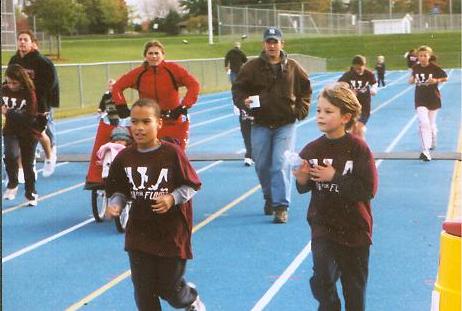
It's Saturday, in the cold, first light of morning. I pull on a heavy sweater and jeans and move silently over the bedroom floor. I am obligated to the dawning day, not to speak. There will be time for that, later. There are errands to run, housework and meals and child-noises: piano practice, homework questions, tussles over chores and toys.
Three hours from now I'll say something before I think, for no real reason, and my words will slip unnoticed into everybody else's noise. Here, in the grey light and silence, a thoughtless word seems crass; irreverent. There is room enough for right words, but few find them, I think.
In the beginning was the Word… I imagine the first morning, when God looked into dark empty space, silent for ages, and filled it up with His words. Let there be light!
I am glad to hold my tongue.
…
The morning evolves from silence to hushed whispers to conversation, from the holy atmosphere of a prayer chapel to the friendly one of a church foyer. Everyone is talking and lively, but not raucous or silly just yet. Holiness lingers.
The whole family heads out early for a school fund-raiser, "Run for Funds". My three oldest boys recruited sponsors- grandparents, aunts and uncles- and are off this morning to run as many quarter-mile laps in the space of an hour, as their child-legs allow. It is near freezing weather, but sunny, crisp and cold like a Michigan apple.
Scott and I hit the track with Eliot and Ethan and I remind the older boys to pace themselves. An hour is a long time to run.
"I know," they both say.
...
It’s all I can do to keep up with two-year-old Ethan, who’s decided he’d rather run the track than ride it in a stroller.
I remember exuberance. It was mine once.
I follow the white lines with my eyes all the way around the elliptical track to where I began. Fire infiltrates my calves, my thighs and creeps into my brain. When did I become this?
A movie starts running in my head: there’s a camera close-up of my face- flushed, sweaty, distorted- smashed against the ground at the finish line. The camera pans up slowly to show Ethan, standing with one foot on my head and his arms in the air, his face smugly victorious…
"I running!" Ethan shouts.
"Yes, you are running, sweetie! You're doing a good job!" I say encouragingly, as I close the gap between us from behind.
Ethan looks delighted, smiles and does a little dance. "Mommy, you catch up with me!"
...
The fall morning is newborn-fresh: violent, dewy, tender and promising. Orange, fire-engine-red, purple and yellow lie cradled in arms of unbelievable blue. Everything exposed to earth and sky today is dipped into a giant vat of golden honey and brought forth dripping, sweet and glowing like the bursting, sun-lit trees.
I am no exception. Suddenly, I know that I am beautiful. I smile up into the painted hemisphere and it smiles warmly in return. I begin running, again.
...
After a lap or two I cease thinking about time. Time is irrelevant. My task is set: I keep moving in the same direction, keep my feet on the baby-blue track. I walk, I run when I can, but always circling, circling, like the seasons. You can argue that there is no point to it, no grand, over-arching purpose, not even a clear destination. We’re just orbiting a green-grass center as if it is our sun.
But moving my body is good, and beauties abound today.
…
A boy and girl in front of me are laughing together and trying to run. They hip-shove each other and tell jokes and I think how much this looks like flirting, but I know it’s not. Chris and Erin are in the fourth grade, and are good pals and they, with my son, Micah, are almost inseparable. I’m surprised he is not with them, now.
In the first week of third grade, Chris’s mom, Suzie, told me how much her son enjoyed mine. He said, “Mom, I think I like Micah as much a Joe.” Joe is a long-time best friend.
Also during the first week of third grade, Micah sat down to dinner full of grunts and facial contortions over a girl named Erin. He told us gravely, “she’s my arch-enemy”. A week later he admitted he thought she was smarter than he was. I told his teacher about their little competition and she laughed, “Yeah, well, I think Micah can keep up with her, too.” By Christmas they were best friends.
“Hi Erin, Hi Chris,” I call out. “Where’s Micah?”
“He’s up there, somewhere,” Erin says, flipping her hand out in front of her and her long hair over her shoulder.
…
When Micah laps me a short while later, his brown eyes are determined and joyful.
“I’m ahead of everyone in my class,” he tells me, and tries to hide the radiance oozing from his pores.
Of my four children, Micah is the one most like me. We fight. Sometimes I’m afraid my love will crush him and other times I’m afraid I’ll lose him, that he’ll just drift away.
I read his school journal the other day. In it, he says that he likes rain, and that his favorite way to spend a stormy day is lying on the couch watching, through the window. When I asked him why he wrote less, as the school weeks passed, he shrugged. “Mrs. Meadows always reads our journals.” He paused. “I don’t like telling people what I feel.”
When I was nine I wanted to be my own mother, because I knew what I needed and my mother rarely did. Now that my son is nine, I have no idea what to do. I know what he’s feeling and I know why he acts as he does, with hostility or flight, when he just can’t shake his need for compassion or to be understood. But I can’t get to him. Antagonism can not be comforted. I know that now and I blame my mom a little less. I search for a gesture or a magic word with which to penetrate his arguments, his pessimism; but the same tool doesn’t work twice.
Micah and I understand each other best when we are sharing something: walking, cooking, talking about a book we’ve both read. When he’s sad and doesn’t know why, he sits in my lap and twists my hair into knots, the way he did when I breastfed him, years ago.
I lost my temper the other day and said awful things, and Micah forgave me as soon as I asked.
“I’m sorry,” I said, again.
“It’s okay”.
“No, it’s not.” I said.
“It’s okay, because I forgive you,” he said. “That makes it okay and you don’t have to say you’re sorry, anymore.”
Micah's anger is intense; but his love is fiercer, by far.
…
Somewhere near the second-mile marker Eliot tells me his shoes are too small and have been for a long time. I buy new things for my oldest son and pull out stored-away boxes for my weed of a toddler. It turns out those kids in the middle grow, too.
Eliot is oblivious to things like too tight shoes. He wears short-sleeves and bare feet on winter mornings, when the house is chilled and the floor tile feels ice-cold. When he is sick, I know it before he does. He plays until he drops and I find him curled in a corner, sucking his thumb and shivering, with fiery skin.
I help Eliot take off his shoes. I carry the shoes in one hand and hold his cold hand in my other. We walk together, his stocking-feet padding the rubber track and his mouth chattering, as it always is.
I love that boy.
…
I’ve not seen Scott for a while, now. First he ran ahead with Eliot, while I lagged behind at Ethan’s pace. Somewhere along the way we switched out kids, but he is still ahead of me.
Scott is always several steps ahead of whomever he is walking with. This summer we met friends in Chicago and we all noticed it. He attributed this to our collective indecision. I attribute it to his eagerness to be, to move, to meet whatever is ahead.
When we walk together, he tells me I slow down when he does, keeping the distance between us. Maybe he’s right. When you’re eighteen and engaged to your first solid boyfriend, then married with a baby before you’re 20, keeping distance stops you from fading out. Still, there is more to it than that. Some Siren in his soul bids him on.
If I want him to keep my pace, I have to hold his hand.
…
“Ten more minutes!” I hear the lap-counters shouting to the runners.
I am crossing the finish line for the eighth time, hand in hand with Eliot, who’s in socks and making a game out of side-stepping goose droppings.
Marshall, who is eleven and still calls me “Mommy”, runs up alongside us. His face is blotchy; cold white skin accented with hot spots of puffy pink.
“Hi mommy,” he says quietly, and slackens his pace. He’s been running for most of the hour.
Marshall talks easily with anyone he knows well, and is remarkably blessed with an immunity to peer pressure. He shakes his head and laughs kindly at trends, the way an old married couple smiles at young love. He builds amazing structures with LEGO’s and designs medieval torture devices which, despite being frightening, are surprisingly well-designed.
I asked him once what he wants to do when he grows up and he said,
“I have this theory that dinosaurs still exist, and I want to prove it.” He thought for another minute, shuffled around a bit, smirked, and said sheepishly, “I don’t know if you can actually do that. You know, for a career.”
Marshall was born a little bit lop-sided. Whether it’s his spine or just his posture, we don’t know; we’ve never looked into it and it’s never been a problem. Scott and I joked about it when he was a baby. When he started running, he ran crooked, too, his left side dragging just a hair behind his right.
Because of this or because of his long, lanky build, or maybe because he’s had a quick mind from the start, our friends and relatives pegged him down right away as smart but un-athletic. When his brother, Micah, arrived two years later with a perfectly proportioned, compact self, he got labeled “athlete”. The truth is that both are misnomers. Micah is sharp as a tack and Marshall holds his own in most sports. As their mother, I know this.
Still, I am surprised. Marshall is running as fast now as he was when we started and I gave him that unneeded advice about pacing. We chat for a bit and then he pulls ahead. He says he needs a drink and then he’s going to finish strong.
I believe him. He has shed his asymmetry, like a too heavy coat.
…
Eliot runs his entire last lap in socks. We make our way to Scott and Ethan, who have finished ahead of us. Marshall and Micah stand a little way off, panting and gulping from bottles of water.
I ask Marshall for his final tally.
“Twenty-one,” he tells me.
“Wow,” I say, in all sincerity.
“Guess what?” Micah walks toward me with a grin. “I got 21 laps!”
The lap-counters confirm him. Marshall and Micah are officially tied as the top lap-runners of the k-6 school.
Micah is jealous and aggressive by nature and his chief competitor is his older brother. Marshall is self-contained and passive, and Micah is his only competitor. The tie seems to satisfy them both.
“Your boys did really well.” I look up to see Miss Albers, the first grade teacher and also the secondary school’s cross-country coach.
“Yeah, I think they had a lot of fun,” I tell her.
“Well, I hope Marshall comes out for Cross-Country next year.”
I’m trying to grasp that my boys just ran five and a quarter miles a piece, in one hour. They are eleven and nine and I am feeling much older than I am.
…
Scott wants to go to IHOP for brunch and we don’t really have money for that kind of thing. But the boys are hungry and they’ve just run their hearts out. We tell them they can have whatever they want to eat and we decide to order hot-chocolates, topped with whipped cream.
When we walk into the restaurant my children’s faces are flushed and rosy-cheeked. I ease myself onto a padded bench and wait for a table.
A man and woman are leaving. I’m not a good judge of age, but they are silver-haired and walking slowly. The man holds the heavy glass door and the lady ducks under his upheld arm. Her eyes take in my clan of disheveled boys and before leaving she turns, smiles toward me, knowingly.
…
Ethan’s legs are wrapped around my waist and his arms cling to my neck. He’s tired and his head droops, until some small pleasure lights his eyes, through the window, behind me. He clutches my hands with expert fingers and balances, stepping on my thighs. He jumps up and down on my lap, singing loudly.
I am weary from a night of little sleep and a morning full of feeling, but I do not ask him to stop. Instead, I fold my face into his hot cheek and draw in my breath. His smell is deep and sweet, the irrepressible scent of life.
Tuesday, November 29, 2005
The Men That Don't Fit In
There's a race of men that don't fit in,
A race that can't stay still;
So they break the hearts of kith and kin,
And they roam the world at will.
They range the field and they rove the flood,
And they climb the mountain's crest;
Theirs is the curse of the gypsy blood,
And they don't know how to rest.
If they just went straight they might go far;
They are strong and brave and true;
But they're always tired of the things that are,
And they want the strange and new.
They say: "Could I find my proper groove,
What a deep mark I would make!"
So they chop and change, and each fresh move
Is only a fresh mistake.
And each forgets, as he strips and runs
With a brilliant, fitful pace,
It's the steady, quiet, plodding ones
Who win in the lifelong race.
And each forgets that his youth has fled,
Forgets that his prime is past,
Till he stands one day, with a hope that's dead,
In the glare of the truth at last.
He has failed, he has failed; he has missed his chance;
He has just done things by half.
Life's been a jolly good joke on him,
And now is the time to laugh.
Ha, ha! He is one of the Legion Lost;
He was never meant to win;
He's a rolling stone, and it's bred in the bone;
He's a man who won't fit in.
-Robert Service
A race that can't stay still;
So they break the hearts of kith and kin,
And they roam the world at will.
They range the field and they rove the flood,
And they climb the mountain's crest;
Theirs is the curse of the gypsy blood,
And they don't know how to rest.
If they just went straight they might go far;
They are strong and brave and true;
But they're always tired of the things that are,
And they want the strange and new.
They say: "Could I find my proper groove,
What a deep mark I would make!"
So they chop and change, and each fresh move
Is only a fresh mistake.
And each forgets, as he strips and runs
With a brilliant, fitful pace,
It's the steady, quiet, plodding ones
Who win in the lifelong race.
And each forgets that his youth has fled,
Forgets that his prime is past,
Till he stands one day, with a hope that's dead,
In the glare of the truth at last.
He has failed, he has failed; he has missed his chance;
He has just done things by half.
Life's been a jolly good joke on him,
And now is the time to laugh.
Ha, ha! He is one of the Legion Lost;
He was never meant to win;
He's a rolling stone, and it's bred in the bone;
He's a man who won't fit in.
-Robert Service
Tuesday, November 22, 2005
Change
In the past few weeks I've heard from three (very) different sources that "People don't really change all that much" over the course of a lifetime.
I'm trying to think this through. This seems right as personality is concerned. But how far does it go? And what role do habits play? And are we prey to certain habits because of our personalities? If habit forms character and habit is acquired through natural proclivities, then isn't our character and very moral fabric determined before we are even born?
Of course, I know this is the old Nature vs. Nurture debate. And I know our families and societies play a big role in habit formation as well. But could I, for example, being a generally standoffish, keep-to-myself person, recreate myself through habit, into a welcoming, engaging, warm, social-butterfly kind of person? Interestingly, in high school I was this for one year. One year in all my thirty-one. What caused my behaviour that one year? Could that change have been sustained had I not suffered personal tragedy and recoiled?
I'm trying to feel out how far habit and will can really take us.
Each time I heard this week the idea of our basic unchanging nature, I became very uncomfortable. It isn't only because I'm scared to death that I'll have to be this for the rest of my life (which I am, by the way) but also because I've found hope and a reason to live and work hard in the idea that change is possible. And because I don't know how to believe in predestination, whether social or theological. ( I am not going to argue the finer points of reformed theology here.) To me, the possibility of change is what redeems the endless cycle of monotony and meaninglessness that Ecclesiastes talks about and which I have lamented over before in this blog.
Anyway, I have to run. I'm late (something which proves change is impossible) for a thanksgiving Feast at my children's school. No time to flesh this out. But I wanted to write something down, so I can think about it more clearly and get anyone else's thoughts on the matter.
I'm trying to think this through. This seems right as personality is concerned. But how far does it go? And what role do habits play? And are we prey to certain habits because of our personalities? If habit forms character and habit is acquired through natural proclivities, then isn't our character and very moral fabric determined before we are even born?
Of course, I know this is the old Nature vs. Nurture debate. And I know our families and societies play a big role in habit formation as well. But could I, for example, being a generally standoffish, keep-to-myself person, recreate myself through habit, into a welcoming, engaging, warm, social-butterfly kind of person? Interestingly, in high school I was this for one year. One year in all my thirty-one. What caused my behaviour that one year? Could that change have been sustained had I not suffered personal tragedy and recoiled?
I'm trying to feel out how far habit and will can really take us.
Each time I heard this week the idea of our basic unchanging nature, I became very uncomfortable. It isn't only because I'm scared to death that I'll have to be this for the rest of my life (which I am, by the way) but also because I've found hope and a reason to live and work hard in the idea that change is possible. And because I don't know how to believe in predestination, whether social or theological. ( I am not going to argue the finer points of reformed theology here.) To me, the possibility of change is what redeems the endless cycle of monotony and meaninglessness that Ecclesiastes talks about and which I have lamented over before in this blog.
Anyway, I have to run. I'm late (something which proves change is impossible) for a thanksgiving Feast at my children's school. No time to flesh this out. But I wanted to write something down, so I can think about it more clearly and get anyone else's thoughts on the matter.
Saturday, November 19, 2005
Harry Potter and Micah King
I took a painting break this afternoon and escorted Micah and his two best friends to the fourth Harry Potter film. I haven't come to any conclusions on the movie, yet. I sat right next to a 9 year old boy who couldn't stop talking, loudly, and replete with spoilers. Of course, I've read the book, so that was okay. Still,I had a hard time following the storyline and I don't know if that was due to the three excited chatterers in my company or simply because the movie failed to produce a solid one. I wondered several times if I'd be able to make any sense of it if I hadn't read it first. But then, the problem may have been my emotional involvement with a much more intricate story than two hours of film can portray.
Micah set up the whole outing. He called Erin and Chris and worked out the time and meeting place. I couldn't help chuckling to myself, watching Harry, Ron and Hermione with Micah, Chris and Erin. Micah and Chris will have to fight a wand-war to determine which of the two gets to be Harry and which gets to be Ron. But Chris has strawberry-blond hair and Micah's got a scar on his forehead, just barely hidden by his disheveled hair.
I wonder sometimes how my sons relate to girls, since there are four of them and they have no sister. Erin has been Micah's friend for about a year and they get along seamlessly.
When Scott went to buy tickets for the 12:50 showing, he found a 1:40 showing in "the big theatre". He phoned Micah to ask if he'd like to change times. Micah said, "Daddy, that's almost a whole hour later, and Erin wants to see it as soon as possible".
We went to the earlier show. He has no idea how cute he is.
Micah set up the whole outing. He called Erin and Chris and worked out the time and meeting place. I couldn't help chuckling to myself, watching Harry, Ron and Hermione with Micah, Chris and Erin. Micah and Chris will have to fight a wand-war to determine which of the two gets to be Harry and which gets to be Ron. But Chris has strawberry-blond hair and Micah's got a scar on his forehead, just barely hidden by his disheveled hair.
I wonder sometimes how my sons relate to girls, since there are four of them and they have no sister. Erin has been Micah's friend for about a year and they get along seamlessly.
When Scott went to buy tickets for the 12:50 showing, he found a 1:40 showing in "the big theatre". He phoned Micah to ask if he'd like to change times. Micah said, "Daddy, that's almost a whole hour later, and Erin wants to see it as soon as possible".
We went to the earlier show. He has no idea how cute he is.
Thursday, November 17, 2005
Melancholy, in Brown and Grey
Update:
To those of you who want me to write more than once a month, I have to tell you that I want to, also. Right now I am behind on several email and letter-writing tasks, which really must come first. Also, we're tearing out carpet in our dining/living room, flooring the former with something more proper to a dining area where four children eat meals, and painting all the walls before the carpet installers come.
Melancholy:
Fall has ended abruptly with six inches of snow. It is wonderful and I love snow. But I wasn't ready for it this year. The week or two after all the loud and glorious colored leaves have fallen and muted is, for me, a cherished time of rest. The breath-stopping world of many colors becomes reduced to a few quiet shades. Trees stand naked and grey and the ground along the sides of the road and on the forest floor is deep brown. The few leaves remaining on the trees and the ones which blow across my yard are chestnut- not orange, but hinting at what orange must be.
When I look out the picture window in my dining room, past my red barn and the woodshed and the sagging chicken coop, I see far into the wood, where there was only leafy closeness before. The hardwood trees are tall, twisted or leaning from years of untiring pursuit after a fleeing sun. These grey phantoms hover over the brown earth, playing endlessly with light and shadow. There's a finality, and a melancholy. But it suits me.
My world is so much bigger for this week or two- until the first snow, and then things close in again. But it is a cheery closeness; clean and bright and undeniably beautiful.
To those of you who want me to write more than once a month, I have to tell you that I want to, also. Right now I am behind on several email and letter-writing tasks, which really must come first. Also, we're tearing out carpet in our dining/living room, flooring the former with something more proper to a dining area where four children eat meals, and painting all the walls before the carpet installers come.
Melancholy:
Fall has ended abruptly with six inches of snow. It is wonderful and I love snow. But I wasn't ready for it this year. The week or two after all the loud and glorious colored leaves have fallen and muted is, for me, a cherished time of rest. The breath-stopping world of many colors becomes reduced to a few quiet shades. Trees stand naked and grey and the ground along the sides of the road and on the forest floor is deep brown. The few leaves remaining on the trees and the ones which blow across my yard are chestnut- not orange, but hinting at what orange must be.
When I look out the picture window in my dining room, past my red barn and the woodshed and the sagging chicken coop, I see far into the wood, where there was only leafy closeness before. The hardwood trees are tall, twisted or leaning from years of untiring pursuit after a fleeing sun. These grey phantoms hover over the brown earth, playing endlessly with light and shadow. There's a finality, and a melancholy. But it suits me.
My world is so much bigger for this week or two- until the first snow, and then things close in again. But it is a cheery closeness; clean and bright and undeniably beautiful.
Friday, November 04, 2005
A Perfect Day
"Today is just about perfect!" I told Ethan.
He was lying flat on his back on the living room floor. He wriggled and kicked, fought me as I wrapped him in a clean diaper.
"The sky is blue, the grass is green, the leaves are brown and yellow and orange and falling from the trees." I said, to distract him.
He relaxed, shifted his gaze to the large picture windows covering one half of a living room wall. The blue front door hung partially open, forgotten by a careless child. The wind ushered in a warm, autumn scent.
...
Fall smells quiet and faintly sweet, like a peaceful death at a good old age, with family standing near. Fall is a slow awakening of the collective human mind as it sobers and turns inward, hushed by the ancient earth as she puts on her extravagant show, and gently covers those who have fallen with her hand-made quilt of fallen leaves.
...
I pointed past Ethan, toward the open door, and we both strained our necks to see a slice of day beyond it.
"The wind is blowing, and the leaves are rustling, and the birds are swooping and chirping," I said.
Ethan giggled and simple delight sparkled in his eyes.
"Chirping!" He mimicked, and laughed again. Ethan is two and likes the sound of words. He considers the sound of a word, as much as its context, when he assigns meaning to it.
"Somebody is burning leaves in a backyard or having a fire in a fireplace." I continued.
"Burning yellow leaves!" he said.
"The day is absolutely perfect." I told him again. "It's gorgeous."
I wrestled him into small denim jeans, a quilted, plaid flannel shirt and sneakers, which his three older brothers wore before him, but which he calls "new", because I pulled them out of storage just a week ago. We walked together to the door and pushed it wide open.
We stood side by side in the threshold in an overabundance of beauty and turned our faces toward the sun, the wind, the rustling and chirping, and the open, fragrant air.
Ethan leaned into it with arms raised above his head and yelled loud, his voice a power of it's own, clear and strong and full of unambivalent joy.
"It's Gorgeous!" He bellowed.
He was lying flat on his back on the living room floor. He wriggled and kicked, fought me as I wrapped him in a clean diaper.
"The sky is blue, the grass is green, the leaves are brown and yellow and orange and falling from the trees." I said, to distract him.
He relaxed, shifted his gaze to the large picture windows covering one half of a living room wall. The blue front door hung partially open, forgotten by a careless child. The wind ushered in a warm, autumn scent.
...
Fall smells quiet and faintly sweet, like a peaceful death at a good old age, with family standing near. Fall is a slow awakening of the collective human mind as it sobers and turns inward, hushed by the ancient earth as she puts on her extravagant show, and gently covers those who have fallen with her hand-made quilt of fallen leaves.
...
I pointed past Ethan, toward the open door, and we both strained our necks to see a slice of day beyond it.
"The wind is blowing, and the leaves are rustling, and the birds are swooping and chirping," I said.
Ethan giggled and simple delight sparkled in his eyes.
"Chirping!" He mimicked, and laughed again. Ethan is two and likes the sound of words. He considers the sound of a word, as much as its context, when he assigns meaning to it.
"Somebody is burning leaves in a backyard or having a fire in a fireplace." I continued.
"Burning yellow leaves!" he said.
"The day is absolutely perfect." I told him again. "It's gorgeous."
I wrestled him into small denim jeans, a quilted, plaid flannel shirt and sneakers, which his three older brothers wore before him, but which he calls "new", because I pulled them out of storage just a week ago. We walked together to the door and pushed it wide open.
We stood side by side in the threshold in an overabundance of beauty and turned our faces toward the sun, the wind, the rustling and chirping, and the open, fragrant air.
Ethan leaned into it with arms raised above his head and yelled loud, his voice a power of it's own, clear and strong and full of unambivalent joy.
"It's Gorgeous!" He bellowed.
Friday, October 21, 2005
Another Word from Barry Lopez
...in case that first one didn't get your soul churning:
(At the end of his journey)
(At the end of his journey)
"I looked out over the Bering Sea and brought my hands folded to the breast of my parka and bowed from the waist deeply toward the north, that great straight filled with life, the ice and water. I held the bow to the pale sulphur sky at the northern rim of the earth. I held the bow until my back ached, and my mind was emptied of its categories and designs, its plans and speculations. I bowed before the simple evidence of the moment in my life in a tangible place on the earth that was beautiful"
Thursday, October 20, 2005
Leaning Into The Light
I returned the voluminous Arctic Dreams to the library yesterday. But not before committing to computer memory the author's reflections following a walrus hunt:
“No culture has yet solved the dilemma each has faced with the growth of a conscious mind: how to live a moral and compassionate existence when one is fully aware of the blood, the horror inherent in life, when one finds darkness not only in one’s own culture but within oneself . If there is a stage at which an individual becomes truly adult, it must be when one grasps the irony in its unfolding and accepts responsibility for a life lived in the midst of such paradox. One must live in the middle of contradiction because if all contradiction were eliminated at once life would collapse. There are simply no answers to some of the great pressing questions. You continue to live them out, making your life a worthy expression of leaning into the light.”
-Barry Lopez, Arctic Dreams
Thursday, October 13, 2005
Oh No, She's Right.
In reading Heather Lende's book, If You Lived Here, I'd Know Your Name, I came across something Annie Dillard said in her book, The Writing Life :
This is striking to me; the simple, straight-forward, clean logic of it. Why is an apparently self-evident truth so difficult to grasp? How can I repeatedly convince myself that the whole of my life will be greater than the sum of its parts?
I keep doing the same things and expecting different results. I choose the same sops and diversions every day, and every evening I swear I'll make tomorrow different.
I've lived long enough to know that change doesn't often descend like a blinding light on the road to Damascus. Most of us have to get there by the sweat of our brows.
I'm restless lately, scared. All the plans I had at ten or twelve or sixteen, lay fallen by the wayside, left to wither in the hot sun or snatched up in the beaks of parabolic birds.
I don't know when I became so weak.
I found a box of letters in the garage yesterday; all the letters I wrote my husband before we were married and were living several hundred miles and two states apart. I wouldn't know that girl if I met her and I'm sure I wouldn't like her. I browsed through the letters, read a few, reluctantly. The only more embarrasing experience I can remember is watching my wedding video.
I was barely nineteen when we married and between the ages of sixteen and eighteen when I wrote those letters, so I should be fair and give youthful naivete its due allowance.
The thing that wont leave me alone though, like a rug I can't shake out, is how happy she was, how self-possessed, how sure. And kind. Granted, she hadn't seen the world yet and knew as much about that life as a baby in utero knows about life outside the womb. But I give her a full ten points for sincerity.
I can't imagine anything less like me, now.
About eight years ago two things happened pretty much simultaneously. I stopped trusting God and I found out abruptly that I couldn't trust myself. That's when everything started to slip. It was the first time I ever yelled at a child. And he was mine.
It's hard to appreciate how far little steps can take us off the path. But I have to believe little steps can bring me back, too.
I'm going to pull out my compass now and head back. I don't know where I came from, so I can't retrace my steps. But when I am very still, I think I can feel my heart leaning True North.
"How we spend our days is, of course, how we spend our lives. What we do with this hour, and that one, is what we are doing."
This is striking to me; the simple, straight-forward, clean logic of it. Why is an apparently self-evident truth so difficult to grasp? How can I repeatedly convince myself that the whole of my life will be greater than the sum of its parts?
I keep doing the same things and expecting different results. I choose the same sops and diversions every day, and every evening I swear I'll make tomorrow different.
I've lived long enough to know that change doesn't often descend like a blinding light on the road to Damascus. Most of us have to get there by the sweat of our brows.
I'm restless lately, scared. All the plans I had at ten or twelve or sixteen, lay fallen by the wayside, left to wither in the hot sun or snatched up in the beaks of parabolic birds.
I don't know when I became so weak.
I found a box of letters in the garage yesterday; all the letters I wrote my husband before we were married and were living several hundred miles and two states apart. I wouldn't know that girl if I met her and I'm sure I wouldn't like her. I browsed through the letters, read a few, reluctantly. The only more embarrasing experience I can remember is watching my wedding video.
I was barely nineteen when we married and between the ages of sixteen and eighteen when I wrote those letters, so I should be fair and give youthful naivete its due allowance.
The thing that wont leave me alone though, like a rug I can't shake out, is how happy she was, how self-possessed, how sure. And kind. Granted, she hadn't seen the world yet and knew as much about that life as a baby in utero knows about life outside the womb. But I give her a full ten points for sincerity.
I can't imagine anything less like me, now.
About eight years ago two things happened pretty much simultaneously. I stopped trusting God and I found out abruptly that I couldn't trust myself. That's when everything started to slip. It was the first time I ever yelled at a child. And he was mine.
It's hard to appreciate how far little steps can take us off the path. But I have to believe little steps can bring me back, too.
I'm going to pull out my compass now and head back. I don't know where I came from, so I can't retrace my steps. But when I am very still, I think I can feel my heart leaning True North.
Friday, September 30, 2005
Child Psychology
Marshall (11), and Micah (9) were chatting it up in the back seat on our way home from school Tuesday.
Marshall: Hey Micah, you know how people who are really good with kids always try to get you to repeat something louder... like, "I can't heeeaaarr you!"
Micah: Yeah.
Marshall: I hate that.
Micah: Me too.
Marshall: Hey Micah, you know how people who are really good with kids always try to get you to repeat something louder... like, "I can't heeeaaarr you!"
Micah: Yeah.
Marshall: I hate that.
Micah: Me too.
Subscribe to:
Posts (Atom)